Tuesday, September 13

Vultures Conservation

Between the 18-22 September, the Israel Ornithological Centre (IOC) together with the Israeli Nature and Parks Authority (INPA) and the Israeli Electric Corporation (IEC) have organised an International Conference and workshop on the Conservation of Vultures in Israel. I will be attending some parts of this workshop and will update on it when I'm back.

Mean while, I would like to get you all into the subject of Vulture Conservation using this great video which was produced as part of the International Vulture Awareness Day in Kenya, a country I have strong affiliation with after living there for 4.5 years (and travelling frequently up and down since 1997).


I think that this is one of the most important conservation issues in Kenya and surely that it is also affecting the birds which migrate into our side of the globe like Egyptian Vultures.  


Numbers of Egyptian Vultures in Israel have fallen down over the last 20 years very drastically, and it is believed to be partly due to their wintering grounds situation.
Griffon Vultures colonies in Israel have shown a very steep decline due to many reasons but one of the most important, is poisoning of cattle as part of breeders battles on grazing land...

Surely I will have much more to say on the subject after the workshop. Mean while, I will be happy if you will distribute this video and also send your comments on the subject.


On the birding front, migrants are coming through. The most interesting one is a beautiful male Ruppell's Warbler which was jumping next to the ringing station at the IBRCE. Re'a got some record shots which I'm sure will come later... and a group of 4 Rose-coloured Starlings flying east towards the Aqaba Bird Observatory 

Monday, September 5

a good one...

Daim, what a fresh morning we had!
As we opened the newly erected mist-nets (put them up yesterday), the great number of Red backed  and Masked Shrikes around. Probably all arrived the previous night…till the end of the day we caught 8 Red's and seen over 30(!) Most being adults.
Here's one for you-

As I got to the "East bank" nets , a yellowish belly caught my eyes vibrating in the net . "what the hell is wrong with this Blackcap?!" crossed my mind. Two steps forward- "it's yellow! It's not smeared with Acacia pollen! Hey, that’s an Icterine Warbler!!"

A rare but regular migrant and a new hand species for me!(not very cooperative model though…)

Over 60 birds, 17 species, finally a descent ringing morning!
Other good birds- a beautiful adult Common Whithroat

A juv Orphean Warbler, quite a few of those are caught and seen these days.

Fun as always-

A late Olive tree Warbler was hopping around, a Lesser Grey Shrike, some Spotted  Flycatchers
Yesterday's evening, the relentless Yotam opened the Swallows ringing season, with a modest but encouraging 16 birds catch.

You can be sure- many more Swallows, carrying foreign rings will get down here soon…

Waders?....wagtails?! …stay tuned !
  

Sunday, September 4

Moonless nights

Ringing on
Moonless nights are known for being good for wader catching. So I spent three nights out at the salt ponds (30/31.8 1/2.9 and 3/4.9) setting-up 90 meters of low (two shelves) mist nets. Wind is the real problem here in Eilat, Strong winds which normally will keep me home in other places blow for the greater part of the night. Yet catching was reasonably good, with birds of a rather normal verity: Little stints, Ruffs, Ringed and Kentish plovers, two Curlew sands and a Redshank.


On the night of the 3/4.9 two more special waders were add to the list: Marsh sandpiper (a ringing tick for me) and Broad billed sand; all in all 48 waders of 8 species in 3 nights, a good beginning.


At the station a great change is underway, during the last days a drop of 5-6 Celsius degrees makes it possible to resume ringing with mist nets, and today we opened 7 of them although no many passerines are around they will soon arrive, and we'll be waiting with open nets. In the 'firsts' section: Collared Flycatcher, Sedge Warbler, Little Crake, Spanish (punish) Sparrow , Willow Warblers  and many (up to 7) Lesser grey Shrikes in the area.
First of many: a Willow Warbler

Juv. Collared Flycatcher (note the worn tail)


Of last week catch, the first Yellow Wag.

Out in the fields we continue to catch Bee eaters as a damage reduction project for farmers. The Bee eaters surprisingly eat the bees the farmers use to fertilize their watermelons crops. The bees react by falling back into the hive and brave the colorful storm by waiting safe inside. This is great for the survival of the bees but damages the farmer's corps as there are almost no natural fertilizers around. We release our catch as far away from the hives as we can: Tabba border passage (14 km).
During a bee eaters catch on the afternoon of the 31st I saw a single Black winged Kite, probably an Asian bird of the ssp. vociferus. A nice bird after a month at Eilat!

Monday, August 29

Sooty Falcon and Autumn migration updates

After 3 days up north, I was happy to come back home and check whether migration is picking up around here as it is up north. I started checking K20 where there were good numbers of Little Stints as well as growing (comparing with last week) numbers of Ringed Plovers, Ruffs, Wood Sandpipers  and few Greenshanks, as well as Alpine and Curlew Sandpipers. 


Also around were the first groups of Sand Martins, 30 Gargany's, 5 Gull-billed Terns, 2 Black Terns and a dozen or so of Whiskered Terns.


The best birds though were a pair of Sooty Falcons that gave great show of both hunting (going mainly after Little Stints and Yellow Wagtails) and displaying. Below are some poor record shots of the male eating the leftovers of a Yellow Wagtail (the white ground cover is from the foam created by the waves).


 After K20 I checked the Acacia woodland around and there were many new migrants in the  foliage: First Willow and Garden Warblers were joining the wave of Lesser Whitethroats that was present already last week.


Indian Silverbills are always nice 
 and there were both Red-backed and Lesser Grey Shrikes present around.


At the IBRCE park, Re'a reported a Barbary Falcon  trying to help control the Ring-necked Parakeet numbers and also the first Great Reed Warbler for the season. in the Melon fields, next to the park, there are new groups of Eurasian Bee-eaters and I heard my first Citrine Wagtail for this Autumn calling.


Back in Beer-Ora, my garden-list keeps on growing with my first Nighingale for the season and by mid day I already spotted my first Honey Buzzard for the season.


Stay tuned and we will update you as the season proceeds.

Saturday, August 20

Autumn Migration is on...

This Weekend, despite all the late occurrences in the area, we had our family coming to celebrate our son's (Uri) 5th Birthday in our house at Beer-Ora.
This morning, while everybody is digesting a great breakfast, my wife's mom, who has a limited interest in birds, was looking out on the lawn and asked me why do the Sparrows in the south look so small?!
I looked towards the birds she was pointing at and found amongst the House Sparrows my first garden Icterine Warbler. Off course that by the time the camera was around, the bird did not, but still, thank you Savta Ruti...

Later during the afternoon, when everybody went to snorkel in Eilat, I decided to stay back and go check K 20 and the area. Comparing with last week there were much less waders around but still some new arrivals like Ruddy Turnestone a group of some 70 Greater Flamingo that by their very alert behaviour seems to be new arrivals (also there were extra 70-100 on their usual pond).
A group of Gargany's and Shovelers joined the many Slender Billed Gulls and the usual group of 10-14 Caspian Terns. Also around were Gull-billed, Whiskered and White-winged Terns. 


Undoubtedly though, the best bird for K 20 was an adult Terek Sandpiper  which kept on flying away and i only managed to get this very poor record shot...


As the time went by and it was getting dark i went out of the ponds and found on one of the Acacia's next to the road (which some will badly consider naming it Senegalia or Vachellia  http://www.acacia-world.net/html/namechange1.html) a trio of 1 Eastern Orphean Warbler and 2 Lesser Whitethroats.  

Driving back home on a small desert road, I was cut by a very fast and powerful flyer that immediately i recognised as a Lichtensein's Sandgrouse . I followed it until it went down on the ground and in the far distance i could count 2 female types and a single male feeding out in the open. Next to them was my first Isabeline Wheathear for the season jumping around, I wish there were more light... 

Let's hope that the current escalation will come to an end we will be able to enjoy a nice Autumn migration. We (Re'a, Yotam and I) are planning to start survey the mountains for Sooty Falcons breeding territories and it will be very hard if the situation won't change.

Stay tuned and we will try to update as the season progresses.

Tuesday, August 16

last days notes

So, species count is rising daily, with an Olive Tree Warbler near the ringing station yesterday and another one today. These badass migrants peak around mid July and those should be considered rearguard (but still the first one I have seen this autumn)!
Other good stuff around from the last days  includes a Black Tern and some 80 Garganys at K20 salt ponds (thanks Itai!), a Sooty Falcon attacking a Barbary Falcon at the Red Canyon (upper Eilat Mountains) – a good clue for a nesting territory. Yesterday, a Black Bush Robin was found at the Hai-Bar reserve near Yotvata, by Shay Kabbessa . Great find and thanks for the photo!

A fledgling Rufus Bush Robin was caught today.


Note the partial post juv. Moult pattern-

A juv Masked Shrike from today-


The Lehnardt family is working full power! Yael is here for 3 days (a vacation from the army), and already mended all the holes at the Heligoland traps, and re-count the rings stock (would take me for ages…)
The relentless Yotam is working on new waders traps; hopefully tomorrow they will prove efficient! 
And how can I neglect the bugs? On Sunday I had a male Red Veined Darter (Sympetroom fonscolombii) at the reedbed of "Anita's lake". The last record of this species (as far as I recall) was during march!
Another good reappearing species I had yesterday - Blue Empror (Anax imperator), again,  a species that was last recorded here during mid-spring.


Itai reports of Red-veined and Violet Dropwings as well as Desert Skimmer (Orthetrum ransonnetii) from Beer-Ora.

The Ischnura senegalensis seem to be doing well hunting tiny insects at the salt pond's shore! Here's a nice "lucky" shot I made last week-

An afternoon walk around Eilat (Holland park area) provided great incounters with some residents- many "baby face" half grown Sand Partridges were running  around, 2 families of Desert Larks, and a noisy bunch of  Arabian Bablers. Just before sunset I found this beautiful Sand Gecko (Tropiocolotes nattereri). This is the smallest gecko in Israel (adults get to 6 cm). the back pattern of this individual is rather odd and unique.


Yotam is going out this evening for a waders catch…so stay tuned!

Monday, August 8

a call for Volunteers!

Autumn is here and to open the season we ask you for your help!
If you have interest of ringing and birding at the IBRCE as a volunteer, we would be happy to hear from you. Apart from ringing, work with us includes gardening, repairing of traps and equipment and general help around the park. Free time for travelling and birding will be given. We prefer volunteers with ringing license and proven experience. 
Accommodation  will be available (at the IBRCE-room with air-condition) but due to budget constrains, we will not be able to provide living expenses during this season. Having a valid International driving license will provide the option of using the park's car. 


Just to mention some species that were Caught and/or seen at Eilat during last few autumns: Black Crowned Sparrow Lark, Oriental skylark,  Hume's, Green,  Paddyfield, Syke's, Cyprus  and Menetries's warblers…Daurian Shrike, Syrian Serin, Caspian&Sibrian Stonechats, Pied Wheatear, "Eastern" Black Redstars, Olive Backed and Buff Bellied Pipits, Citrine Wagtail,  Black Winged Kite, Crested Tern and many more…   
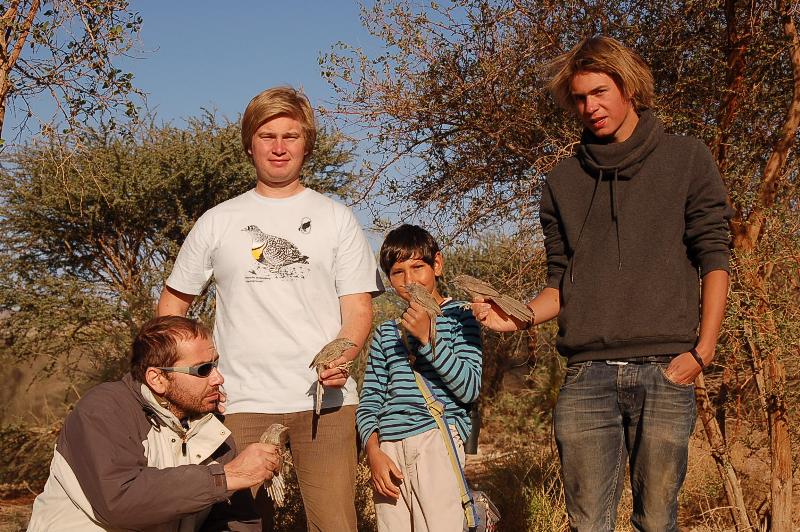
You may have seen some of the photos below in previous posts, but just to remind you how good looking our volunteers are and how much fun we share:
Dutch, Finish, Bulgarian, and Israeli (sound like the beginning of a joke)…

The Swedish-Spanish connection-
Our Top Model, Teun Van Kassel of Holland-


Please contact us by Email at:


And of course some birding updates: today we ringed our first Eastern Olivaceous Warbler and Reed Warbler for the season! A somewhat out of date Steppe Buzzard flew overhead as well…