Showing posts with label English. Show all posts

Monday, June 11

April & May 2012 around Eilat: a summary of a great season.

Birding during April and May was still very productive with lots of migrants all over. The IBRCE ringing station was working very hard and surely the guys have broken some records with the amount of birds that they handled over the whole season and i just hope that after being so busy they will all have good memories from this magical place. I hope to see them all coming back one day. I am still waiting for the season ringing totals from Yotam and I’m sure that once he will finish pinching all the data we will get a full and interesting report. 

While migrants seemed to slow down towards mid April, we still got some really nice waves towards the end of the month mainly of waders and raptors, but also passerines (as will be published later by Yotam). 

Marsh Sandpipers were aggregating in big numbers at K20 and at the IBRCE ponds and the numbers of Red-necked Phalaropes were also rising to a record number of 42 in a single group. The first Broad-billed Sandpipers arrived on the April 10th and later were seen in numbers which rose to 20 and more. Interestingly, at the same dates we already had our first fledged Kentish Plovers running around at K20.  
 This season was exceptional with Caspian Plovers and indeed, 2 late birds appeared also at K20 on April 15th (becoming the 12 and 13 individuals I’ve seen in person only this spring). 


A Eurasian Curlew was seen on the 16th April and Lichtenstein’s Sandgrouses were pairing in breeding territories. 


Towards the end of April more and more groups of White Storks were seen migrating together with big thermals of Steppe & Honey Buzzards as well as Levant Sparrowhawks. While it is always a treat to see birds landing in the middle of the desert to roost, this small group of White Storks was a nice surprise while searching for Hoopoe Larks territory. 


Rock Thrushes were still moving through the Arava till late April and on May 1st while birding around Yotveta, I found this wonderful Dunn’s Lark which was later photographed by Yoav Perlman who was nearby and could come for a twitch. 


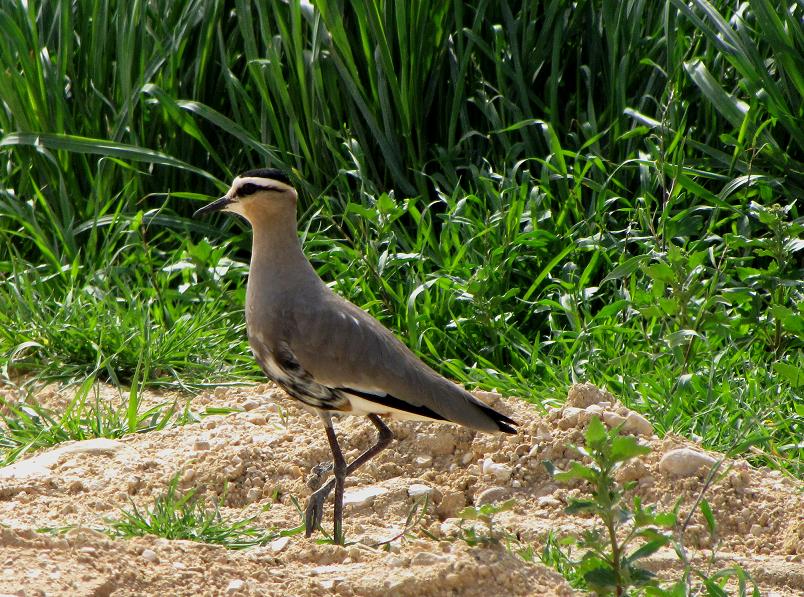
A late Montagu’s Harrier was a nice surprise on the first week of May, but even more so was this lone Terek Sandpiper which are always not too common in Israel both joining flocks of Gull-billed and White-winged Terns.


A very interesting bird was found by Noam Waiss and John Kormendi (sorry if there are spelling mistakes) swimming on K19. It was one of the most interesting identification debate I had for some time, going back and forth from Common to Barrow’s Goldeneye and at last deciding that this is a 1st summer male (!) Common Goldeneye. At the same time more and more intriguing Pratincoles were seen by different people at different locations and I presume that we will have much on this in the future...

Our local species were already in full breeding during early May and at the same time Eurasian Honey Buzzards were flying all around with mornings of thousands of birds taking off from the date plantations along the Arava. Among them were few Oriental Honey Buzzards I managed to get a nice glimpse on few of them, but surely this adult male was the most attractive one (sorry for the poor quality of photos...) 

On May 17th I met Mr. & Mrs. Deighton’s from South Africa at Holland Park and found a nice Barred Warbler which they were looking for. I than directed them to Neot-Smadar sewage to look for some other species they were after. Not only did they found the Upcher’s and Olive-backed Warblers around, they managed to send rare bird alert regarding the most cooperative Black Bush Robin i’ve seen in many years... 

A Terek Sandpiper which was seen on May 30th represent the 3rd for the season that seemed to have completely finished now, leaving us with these great breeding species which are colouring our beloved desert. 

On June 9th, a visiting birder (Dudu Raved) had the first Bridled Tern flying around, soon we will have more of these flying at the gulf of Aqaba and since July is just around the corner, autumn migration is surely going to be another great time...

Saturday, June 9

No Words...

Its been much too long and I don't have any excuses...

but just to break the ice again (which is really needed now around the boiling Arava), I thought to share this photo of our own Avi Meir who is enjoying the local breeding season of Little Green Bee-eaters. I hope to update soon and put some summarizing data of our last Spring which has been the best in 15-20 years both for bird numbers and bird diversity.


Itai  

Friday, April 6

What a Spring...

It has been two weeks since we've last updated this blog and it feels like a whole season has passed by already... The ringing station at the IBRCE has been very productive with a total ranging roughly around 7250 birds trapped only during March (of which 40-50% were trapped during the last week of March alone!)

The Eilat region is going through probably one of the best Springs we had for 15-20 years despite the fact that we only had 2-3 mm or rain during winter. Surely this must be an outcome of the very wet conditions this year in East Africa.

An unprecedented wave of Pied (15-20 which were seen) and Cyprus Wheatears (20-25 which were seen) was going through the area. Within the Pied, we also had at least 2 different 'vittata' types for the first time in Israel and to top the ice, the 'Basalt' Mourning Wheatear (which surely deserve a species status by itself) was seen throughout this 2 weeks all joining the common Black-eared Wheatears.
1st summer Pied Wheatear
'vittata' Pied Wheatear
Cyprus Wheatear

'Basalt' Wheatear
Black-eared Wheatear

Numbers of Rufous-tailed Rock Thrush, Cretzschmar's Bunting, Chiffchafs, Balkan Warbler, Tree Pipit and 'samamisicus' Redstarts were all very high and made the birds very visible in the field throughout the Southern Arava.


At least 3 different Menetrie's Warblers were seen in different location and 2 more were ringed at the IBRCE park. Other Sylvia's, like Ruppell's, Eastern Orphean, Lesser Whitethroat were also seen in very high numbers throughout. 


Caspian Plovers were reported almost daily from different localities and the Ovda Valley was packed with Short-toed, Bar-tailed, Thick-billed, Temminck's and Bimaculated Larks on most days and Hoopoe Larks  can be found in most of their usual territories around the Arava.


Raptor migration up in the mountains is proceeding in very high numbers as well. at most days we had an early passage and quite high, but during the last week or so numbers have risen and we have constant flow of mainly Steppe Buzzards, but among them one can easily find Steppe, Lesser Spotted & Greater Spotted Eagles, Booted Eagles, Ospreys few Imperials and the first Levant Sparrowhawks were also seen flying around.
During the last few days things have calmed down, and still there are very high numbers of birds all over and Waders numbers have grown including some 20-25 Red-necked Phalaropes and 5-10 Greater Sand Plover. Raptor migration seems to continue still in very high numbers and thousands are passing daily in a very broad front over the southern Arava and the Ringing team report of 2-3 female type Pied Wheatears seen around the northern plantations over the last few days (a female wave?!)
 
Personally, I am still overwhelmed from the amount and variety of birds that we see here this spring, so for our international visitors, like Martin Garner (Birding Frontiers), Neil Glenn (Twitch and Pitch) and Laura Kammermeier (Birds, Words, Websites) which were joining as at the Eilat 6th migration Festival, this has truly been an amazing experience and their blogs projects it quite nice...


Stay tuned as we still have 1.5 month of migration ahead of us and there is still much to be found...
Itai

Thursday, March 22

Enigmatic birding...

It has been a while since i last wrote anything, but there is so much work and so much to to see out in the field that i feel a waste to sit next to the computer.

Nevertheless here is a short summery of birds in the Eilat region:
This is probably the best Spring we had around Eilat in 15 years with both numbers and variety of species, bringing Eilat back to its best.

The bushes are filled with migrants: Sylvia's are all over (including many Ruppell's few Subalpine, still some Cyprus and many Lesser Whitethroats  and Blackcaps). In the City parks there is very good representation of many other passerines groups like Buntings and Redstarts as well as few Shrikes. Also, a very good wave of both Cyprus and Pied Wheatears is going through the region as can be seen in the last few posts... and few Rock Thrushs are also present.

After 3 days of dust storm the sky were clear today and raptor migration was really kicking    with many Steppe Buzzards and still good numbers of Steppe Eagles. Also today 2 Osprey and a Greater Spotted Eagle flying north and more Egyptian Vultures  and Black Storks.

Yesterday I received a report that a probable "Basalt Wheatear" an endemic subspecies of Mourning Wheatear which is only known to breed in the Basalt desert of East Jordan and Southern Syria was seen up at the Ovda Valley by Itai Berger and Daniel Berkowic. 

This bird has a very strange behaviour of crouching forward, which I never noticed with Mourning Wheatear and I usually associate it with Finche's Wheatear. Surprisingly when Hadoram Shirihai arrived and explained about the results of his current work on the morph, he mentioned the same behaviour as a very diagnostic feature.

This is the 6th record to Israel (when accepted) and is probably on the way to be announced as a full species based on work carried by Hadoram Shirihai et al during these days.

I managed to relocate it today after a long search by many others and in few hours many of the visiting birders have managed to come and twitch the bird.

Up at Ovda Valley, there are still some 40 Thick-billed Larks and 10-20 Bimaculated Larks have joined the many Short-toed Larks And in Yotveta a beautiful adult Caspian Plover.

Back at the IBRCE, we were joined by Hadoram and together went through the re-description of the 'eilatea' subspecies of Sand Martins which is a tiny little bird and is probably also going to be split one day as a full species?!  

Sunday, March 4

It's just getting better...

The recent weather with all these southern winds and clouds of dust have settled and many migrants are evident all over.


On Sat' morning I took my young son, Raz who is only 2.5 years old to have a short drive and walk in the desert to see what can we find after the storm. A short walk it was but very productive nevertheless. We started at Km 33 where we had the beautiful song of a Hoopoe Lark and good views of both Asian Desert Warbler and my first for this season Black-eared Wheatear. In the sky, a flock of 250 Eurasian Cranes were heading north giving their very diagnostic calls. 
Earlier in this morning, Avi was photographing nearby, a group of Thick-billed and Bar-tailed Larks (I hope that soon we will get some tastes of these...) 


We than drove south and on our way spotted many Sylvia's including Ruppell's, Eastern Orphean and the most common Sardinain and Lesser Whitethroats. 
When we reach the K 20 ponds, Raz was very happy to point all the Flamingos and was showing his first steps in identification when he asked "what are these Flamingos in the water which are not Flamingos"? aiming on a group of Shelducks...
Later we also spotted male and female Hooded Wheatears and beautiful Kentish Plovers.


As we were driving to leave the ponds, I noticed a bush of Taily Weed Ochradenus baccatus filled with Sylvia warblers. In this single bush, we had at least 3 Cyprus Warblers (2 males and 1 female), Eastern Orphean, Lesser Whitethroats and a second female type Hooded Wheatear.


In the evening we scheduled to meet up with Will, the David's and Jason (who were having a great day up in the Negev), Rune who had a male Crested Honey Buzzard coming to roost at the Date plantation north of the IBRCE, to check the Yotveta fields for some night-life.


We ended this evening after very close encounters with two Egyptian Nightjars (first for the season), Pale Scops Owl - not often one gets to see these wonderful creatures hunting in a field (thanks to Shay for these superb photos of it when it perched), some 10 Stone-Curlews and great views of Golden Jackals, Red Foxes, Cape Hares and a possible Striped Hyena which was too far for confirmation. 


As much as we tried, we couldn't locate the Pharaoh Eagle Owl but hey, we need to leave something for their next visit...


Today (Sunday) Rune the Danish birder reported of an Ad male Rock Thrush at Yotveta.

Thursday, February 23

Sociable Plover or Hoopoe Lark?!

Another day at the IBRCE produced a good number of Chiffchafs and more Savi's WarblerSteppe Eagles were moving in lower numbers today (or because the wind has reduced, they all went higher in the sky?!). Dead-sea Sparrows are becoming exceptionally beautiful at this time of the year and it is a real treat to handle them.


Towards the end of the morning ringing session, I was joined by Rune from Denmark who has been birding the country for the last 5 weeks and has 2 more to go...

Yesterday we both enjoyed the great stream of Steppe Eagles and today we were planing to try and find the Sociable Plover which was found yesterday by David Schoneveld at Yotveta fields. This was a Life bird to Rune and I was very happy to help him find it.

It didn't take us long before we found the bird, exactly at the same spot it was reported yesterday by David and also earlier this morning by Liron Ziv. It is such a privilege to see this species in its breeding plumage and enjoy these very close encounters.


 On our way back towards Eilat, we decided to check few more spots along the Southern Arava and not surprisingly, we found very few birds moving around in the heat of the day. Note worthy was a possible Buff-bellied Pipit among the many Water Pipits which we saw in a very bad light condition and without the scope at Elifaz Sewage.

But, as we drove around Samar Dunes, we stumbled upon a pair of Hoopoe Larks a species which was one of Rune top desires. Another Life bird!


When we headed back home, we had a group of Dorcas Gazelles around Ein Evrona and  I was wondering to myself, which species is more 'sexy' to open this post and couldn't decide. Any ideas?